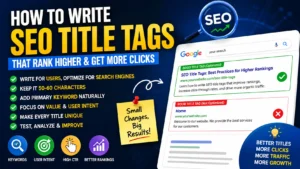
If you’ve ever wondered why one page ranks well but receives very few clicks while another attracts a steady stream of visitors, the answer often starts with the title tag.
Your title tag is usually the first impression people get of your website on a search engine results page. Before visitors read your content, browse your services or explore your portfolio, they read your title. Within a few seconds, they’ve already decided whether your page is worth clicking.
A strong SEO title goes beyond placing a keyword in the headline. It should explain what the page offers and give people a genuine reason to click. It’s about combining relevance, clarity and curiosity into a single line that convinces both search engines and real people.
As search continues to evolve with AI-powered experiences, title tags remain one of the strongest on-page SEO signals. While Google’s algorithms have become much smarter at understanding page content, a well-written title still plays a vital role in improving visibility, increasing click-through rates and setting clear expectations for users.
In this guide, you’ll learn how to create title tags that not only help your pages rank but also encourage more people to choose your website over the competition.
Whether you manage a company website, publish blog content, work in digital marketing or simply want to improve your SEO knowledge, these practical tips will help you create title tags that stand out in search results.
Key Takeaways
Before diving deeper, here are the most important lessons to remember.
- A title tag is one of the strongest on-page SEO elements.
- Aim for a title length that remains fully visible in search results while still communicating the page’s purpose clearly.
- Place your primary keyword naturally towards the beginning whenever possible.
- Focus on user intent instead of simply adding keywords.
- Clearly communicate the value visitors will receive after clicking.
- Avoid stuffing keywords or creating misleading titles.
- Make every page title unique across your website.
- Include your brand only when it adds credibility or recognition.
- Optimise for humans first and search engines second.
- Review your title tags from time to time and refine them using insights from your SEO reports and search performance.
Even small improvements to your title tags can lead to noticeable increases in organic traffic over time.
What Are SEO Title Tags?
A title tag is an HTML element that defines the title of a webpage. It appears in the browser tab and is commonly displayed as the clickable headline on search engine results pages.
Although visitors rarely notice the HTML behind a page, search engines rely on title tags to understand what the content is about. At the same time, users depend on the title to decide whether your page is worth opening.
Long before someone opens your page, the title tag helps them understand what the content is about and whether it matches what they’re looking for. It’s often the first thing people notice in search results and can influence whether they choose your page over another. Even if your content is outstanding, people may never enter if the headline doesn’t capture their attention.
Here’s a simple example:
Poor title:
Home
This tells search engines almost nothing and gives users no reason to click.
Better title:
SEO Services for Small Businesses | Rohith Ulleri
This version clearly explains the page’s purpose while introducing the brand.
A good title tag serves three important purposes.
It helps search engines understand your page
Search engines analyse your title alongside other ranking signals to determine the topic of your content. While Google considers hundreds of ranking factors, the title tag remains one of the most important pieces of on-page information.
It encourages people to click
Ranking first doesn’t always guarantee the most traffic. If your title isn’t engaging, users may choose another result instead. That’s why improving your click-through rate (CTR) is just as important as improving your rankings.
A compelling title can significantly increase organic traffic without changing your rankings at all.
It improves user experience
Clear titles set accurate expectations before visitors land on your website.When your page delivers exactly what the title promises, visitors are more likely to stay, explore your content and complete the action you want them to take.
This positive user experience can also support your overall SEO performance over time.
In short, a title tag isn’t simply another SEO task to tick off your checklist. It’s one of the most influential elements that connects search engines with real people, helping your content get discovered and clicked.
How to Write an Effective SEO Title Tags
Writing a title tag is more than finding the right keywords. A successful title balances SEO with human psychology. It should tell search engines what your page is about while giving people a clear reason to click.
The best-performing title tags are simple, relevant and focused on the reader’s intent. Instead of trying to impress search engines with multiple keywords, concentrate on creating a title that accurately represents your content and stands out in search results.
Let’s look at the key principles that make an effective SEO title tag.
Get the Length Right
One of the most common mistakes is writing titles that are too long. Search engines don’t limit title tags by character count alone. Instead, they display titles based on pixel width, which means longer words can be cut off even if the character count seems acceptable.
As a general guideline, aim for **50 to 60 characters**. This range usually allows your complete title to appear on both desktop and mobile search results.
For example:
Too short
SEO
This gives almost no context.
Too long
The Complete Guide to Learning Search Engine Optimisation for Beginners and Business Owners in 2026
Much of this title is likely to be truncated.
Optimised
SEO Title Tags: Best Practices for Higher Rankings
It’s concise, descriptive and easy to read.
Remember, every word should earn its place. If a word doesn’t add meaning or encourage clicks, consider removing it.
Front-Load Your Target Keyword
Search engines pay close attention to the beginning of a title tag. Placing your primary keyword near the front helps both search engines and users quickly understand the topic of your page.
Let’s say your main keyword is SEO Title Tags. Here’s how a small change in wording can make a noticeable difference.
Less effective
Everything You Need to Know About Improving Your Website with Better SEO Title Tags
More effective
SEO Title Tags: Best Practices for Better Rankings
The second example immediately communicates the topic and is much easier to scan.
That said, avoid forcing your keyword into every title. It should fit naturally within the sentence. If the wording sounds awkward, rewrite the title instead of repeating keywords.
Modern search engines can recognise the meaning behind naturally written phrases, making clear and readable titles a better choice than those filled with repeated keywords.
Show the Benefit or Value
People don’t search because they want information alone. They search because they want a solution.
Your title should clearly communicate what readers will gain after clicking your page.
Ask yourself:
- Will they learn a new skill?
- Will they solve a problem?
- Will they save time?
- Will they avoid a costly mistake?
- Will they discover expert advice?
Compare these examples.
Basic
SEO Title Tags Guide
Value-driven
SEO Title Tags: Improve Rankings and Get More Clicks
Another example:
Basic
Technical SEO Checklist
Better
Technical SEO Checklist to Fix Common Ranking Issues
The second version immediately tells users why the page is worth reading.
Whenever possible, highlight a clear outcome rather than simply describing the topic.
Use Power Words, Modifiers and CTAs
Even minor adjustments to your title can encourage more people to click on your search result.
Power words create curiosity and encourage action. Modifiers add context, while subtle calls to action make users feel they’re about to discover something valuable.
Examples of useful power words include:
- Proven
- Essential
- Practical
- Ultimate
- Complete
- Easy
- Powerful
- Smart
- Expert
- Effective
- Simple
- Advanced
- Actionable
Useful modifiers include:
- 2026
- Step-by-Step
- Beginner’s Guide
- Expert Tips
- Checklist
- Examples
- Best Practices
- Free
- Updated
You can combine them naturally within your title.
For example:
- Best SEO Title Tag Tips for Higher Rankings
- Complete Guide to Writing SEO Title Tags
- SEO Title Tags Explained with Practical Examples
- Step-by-Step Guide to Optimising Title Tags
- Essential SEO Title Tag Checklist for Beginners
Avoid overusing sensational phrases such as “You Won’t Believe” or “Guaranteed Number One Ranking”. These may attract attention, but they can also reduce trust and increase the chances of Google rewriting your title.
Instead, focus on clarity and genuine value.
Writing for People First
While SEO is important, your audience should always come first.
Imagine you’re searching for information yourself. Which result would you click?
Usually, it’s the one that answers your question clearly, sounds trustworthy and promises genuine value.
A good title tag achieves three things in a single line.
It gives search engines a clear indication of the primary topic covered on the page.
It reassures users they’ve found the right result.
It gives them a compelling reason to click.
When these three elements work together, your title becomes far more than an SEO element. It becomes the gateway to your content, helping turn impressions into visits and visitors into potential customers.
Why Google Rewrites SEO Title Tags and Ways to Reduce It
You might spend time crafting the perfect title tag only to discover that Google displays something completely different in search results. This is more common than many website owners realise.
Google’s goal is to provide users with the most relevant and accurate title for every search query. If its systems believe your original title doesn’t clearly describe the page or isn’t helpful for searchers, it may generate an alternative title using information from your page.
While Google doesn’t rewrite every title, understanding why it happens can help you create titles that are more likely to appear exactly as you intended.
Why Google Changes Title Tags
Google may replace your title tag if it:
- Is too long or too short.
- Contains repeated keywords.
- Uses generic wording such as “Home” or “Untitled Page”.
- Doesn’t accurately reflect the page content.
- Includes excessive branding.
- Appears misleading or clickbait.
- Repeats the same title across multiple pages.
For example:
Original title
Best SEO | SEO Services | SEO Expert | SEO Agency | SEO Company
This title is overloaded with keywords and doesn’t read naturally.
Google may instead display something like:
SEO Services for Small Businesses | Rohith Ulleri
The rewritten version is clearer, more descriptive and provides a better experience for users.
How to Reduce the Chances of a Rewrite
Although you can’t completely prevent Google from rewriting titles, you can significantly reduce the likelihood by following a few best practices.
Write descriptive titles
Every title should accurately summarise the content of the page. Avoid vague phrases that leave users guessing.
Keep titles concise
Titles that fit comfortably within Google’s display limits are less likely to be shortened or rewritten.
Match the page content
Make sure your title accurately represents the primary focus of the content on the page. If users click expecting one thing and find another, Google may choose a more suitable title.
Avoid keyword stuffing
Repeating the same keyword multiple times doesn’t improve rankings. Instead, it makes your title harder to read and more likely to be replaced.
Create unique titles
Every important page on your website deserves its own title. Duplicate title tags make it difficult for search engines to distinguish between pages.
Ultimately, Google rewards titles that prioritise clarity over manipulation.
Title Tags in the Age of AI Overviews
The way people use search engines is changing as AI becomes a bigger part of the search experience. Features such as AI Overviews provide users with quick summaries directly within search results, often reducing the number of clicks on traditional listings.
Despite these changes, title tags remain incredibly important.
When users decide to explore a source beyond the AI-generated summary, the title is still one of the first elements they see. A compelling title helps establish trust and encourages users to visit your website instead of a competing source.
Looking for SEO service Click here
Contact me for a free consultation. Click here